

When to use file uploads
Upload files directly when you:- Need to convert IFC data to Speckle format
- Don’t have the source application or license
- Want to view a model quickly in your browser
- Receive files from collaborators who don’t use Speckle connectors
- Work with file formats that don’t have a dedicated Speckle connector
Uploads and connectors produce different datasets
This matters beyond visual fidelity. Intelligence dashboards, Data Validation, Power BI and any querying you build on model data all read the published objects and their properties. If some models in a project arrive by upload and others by connector, those tools are comparing unlike data — counts, groupings and validation results can differ for what is nominally the same source file. Choose one route per project and stay with it, and be explicit about which route produced any figures you report. The two routes serve different purposes. Uploads read a file, so they cover formats and situations where no connector exists or the authoring application is not available. Connectors run inside the authoring application, so they can carry data that lives in the session rather than the file — selection and view filters, coordinate settings, and application-specific properties. See the format details below for what each upload path carries.Upload a file
Upload limits: Maximum file size is 2 GB for all plans and formats.
1
Create a project
Select the option to upload a file.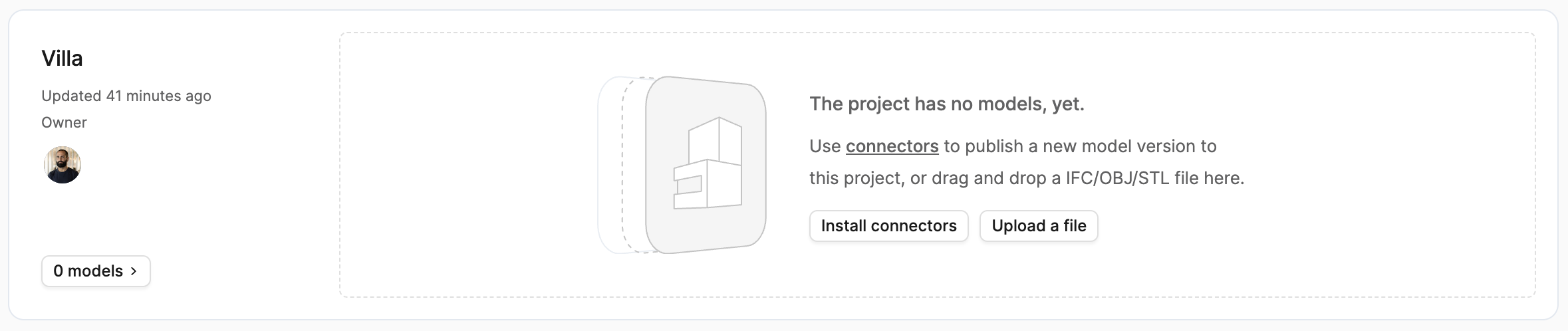
2
Add your file
Drag and drop your file into the project. Speckle creates a new model with the file name.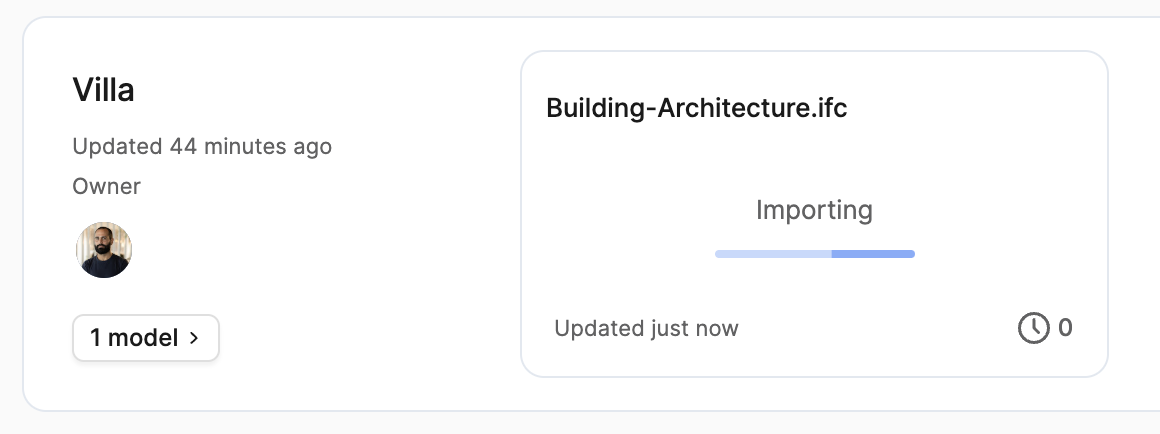
3
Upload new versions
To upload updated versions, select the dropdown menu on the model.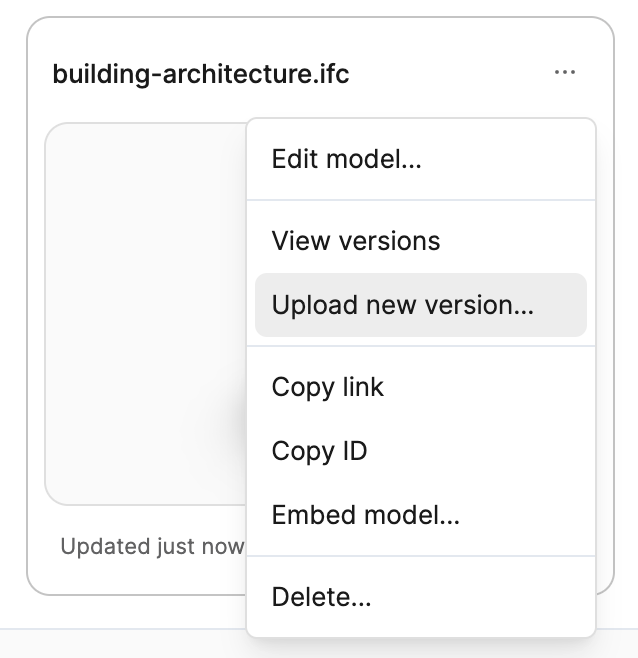
Supported file formats
Speckle supports the following file formats:If your Autodesk (or other) software can export a Navisworks Cache file (
.nwc) or a Navisworks
Document file (.nwd), you can upload it to Speckle without owning a Navisworks license.Want to help improve this flow? Join the user testing study for NWC and NWD uploads with ACC sync
on the User testing opportunities page.
Navisworks online parsing works up to the 2 GB upload limit. ACC sync of NWC and NWD files has
been tested to 6 GB. A publish around 200 MB is still advised from the 2026.8 desktop
connector. See Navisworks in 2026.9.
Unit Conversion
For several file formats, the Unit system of the source file will be automatically detected and preserved when sending through Speckle.- IFC ✔︎
- 3dm ✔︎
- DGN ✔︎
- SKP ✔︎
- STP ✔︎
- FBX ✔︎
File format details
IFC
IFC files are converted to Speckle format with support for attributes, property sets, and quantities.Supported versions: IFC2x3, IFC4, IFC4x1, IFC4x2, IFC4x3
Features:
- Element and element type attributes
- Property sets
- Element quantities
- IFCSpaces are published as volumetric geometry
Known limitations:
- IFC2x2_FINAL and Release Candidate versions aren’t supported
- Alternative formats such as XML, ZIP, and databases aren’t supported
- 2D types like IfcAnnotation aren’t currently supported
Rhino (3DM)
Rhino files maintain geometry and layer structure when uploaded.If you need object names, user strings, render materials or named views, publish with the Rhino
connector instead.
Known limitations:
- Rhino 9 files aren’t supported
- Dynamic text isn’t supported
SketchUp (SKP)
SketchUp models are converted with geometry and basic organization preserved.If you need SketchUp attributes, publish with the SketchUp connector
instead.
Known limitations:
- Attributes aren’t imported
- Dynamic components may not transfer correctly
DWG and DXF
Upload AutoCAD drawing files directly.If you need object properties such as xdata carried through, publish with the AutoCAD
connector instead.
Known limitations:
- Large files may take longer to process
- Dynamic text isn’t supported
Wavefront (OBJ)
OBJ files are converted with geometry preserved.Known limitations:
- Materials aren’t supported
FAQ
Why are my models in the wrong location?
Why are my models in the wrong location?
Direct uploads convert models using Internal Origin and do not apply Revit Shared Coordinates. Uploaded models are not placed in a coordinated space. For coordination workflows that rely on Shared Coordinates, use the Revit connector to publish and load models so coordinate modifications are preserved.
Can I download uploaded files?
Can I download uploaded files?
Yes, file downloads are available. To download a file
- Select the dropdown menu (…) on the model.
- Select View uploads.
- Select Download next to the version you want.
My file is too large to upload
My file is too large to upload
The limits on file uploads are currently 1000MB for all plans and all formats.
Why is my file stuck processing?
Why is my file stuck processing?
We use a queue system to process files, so it can take awhile to generate the Speckle model after you upload your file. If you do not see your model after a long time, this may be caused by faulty items inside your file. Please report your problem in our Community Forum and include the following information:
- Your file type and version
- Your failed file
Will you support additional formats?
Will you support additional formats?
We’re always looking to expand format support. Let us know which formats you’d like to see in future releases.